
 0
 0
By La Reine Aminata Kitambala
In the Walendu-Pitsi sector, Djugu Territory, Ituri Province, environmental protection and the economic recovery of local communities have emerged as two closely interconnected challenges. In a message addressed to the population on Saturday, November 7, 2026, the sector chief, Kpari Chumo Dieudonné, called on residents to resume agricultural activities, protect the hills and rely on their own initiatives to drive local development. “Development will not fall from the sky. It will come from ourselves, our agriculture and our own efforts,” he emphasized, while urging the government and its partners to increase investment in an area that has long suffered from armed conflicts.
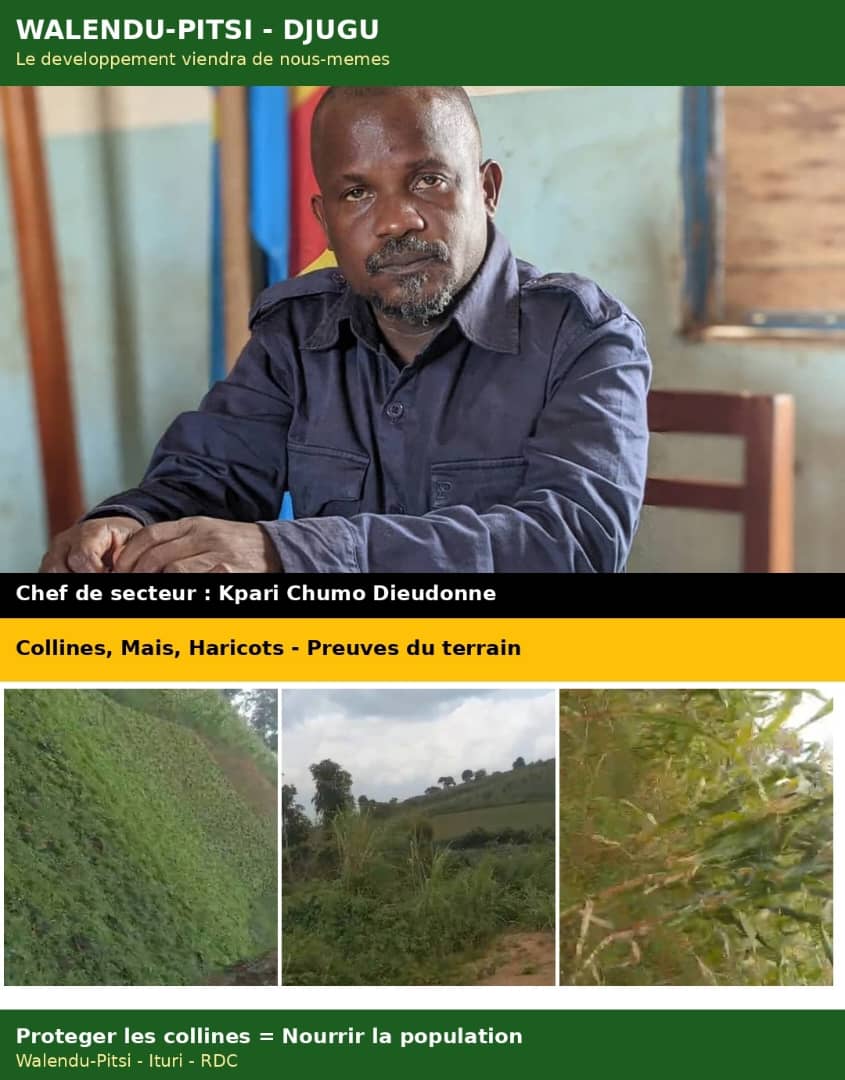
Footage filmed in the field nevertheless reveals a natural heritage that deserves particular attention. Despite the consequences of violence and population displacement, several hills still retain wooded areas, tree-covered hilltops and fallow land where natural vegetation has gradually regenerated. These areas represent significant ecological assets for soil conservation, the protection of water resources and the preservation of biodiversity. For Walendu-Pitsi, the challenge is therefore not limited to restoring degraded land, but also involves protecting the natural areas that remain intact before they disappear.
This environmental situation is closely linked to the region’s security history. Armed clashes have forced many residents to abandon their villages and agricultural holdings in search of refuge, particularly in Nizi, Mungwalu, Bunia and other localities. These displacements have progressively disrupted farming activities, weakened land management and contributed to the disappearance of some tree nurseries and protective hedgerows. The current situation is also characterized by insecurity caused by armed groups, which prevents communities, regardless of their ethnic background, from working peacefully. In this context, the resumption of agriculture and environmental protection remain closely dependent on the restoration of lasting security.
Observations from the videos nevertheless demonstrate the determination of some communities to resume their agricultural activities. Maize fields cultivated on slopes, young bean and pea plants, as well as areas left fallow, illustrate the farming practices that remain prevalent in this part of Djugu. Crop rotation, particularly involving maize, beans and peas, offers an effective approach to maintaining soil fertility, while vegetated areas and trees preserved on hilltops help reduce soil erosion. However, the exposure of certain plots to rainfall highlights the urgent need to strengthen soil conservation measures, particularly through anti-erosion hedgerows, the maintenance of vegetation cover and community-based reforestation.
Beyond individual initiatives, several challenges require a coordinated response involving local communities, public authorities and development partners. These include strengthening local tree nurseries, promoting improved cookstoves to reduce pressure on forest resources caused by charcoal production, protecting water sources and improving farmers’ access to seeds, tools and technical training. The rehabilitation of agricultural feeder roads is also a priority, as it would enable farmers to transport their produce to markets in Nizi, Mungwalu and Bunia. In this regard, promoting four strategic crops — potatoes, maize, beans and peas — could simultaneously contribute to food security, income generation and the preservation of soil fertility.
In response to these challenges, sector chief Kpari Chumo Dieudonné has issued a twofold appeal. He urges residents to mobilize, return to their fields, work collectively through agricultural associations and protect the hills, which constitute their most valuable agricultural and environmental heritage. He also calls on the Congolese government and humanitarian and development partners to provide tangible support through agricultural projects, reforestation programmes, the establishment of tree nurseries, the distribution of improved seeds and the rehabilitation of rural infrastructure. He further stresses the need to secure agricultural areas so that displaced populations can return to their land and resume their activities without fear of violence. In his view, Walendu-Pitsi’s development must be built on the complementarity between community efforts and institutional investment.
In Walendu-Pitsi, environmental conservation therefore goes beyond ecological concerns: it represents a major challenge for economic recovery, social cohesion and sustainable reconstruction after years of conflict. Protecting the hills, restoring agricultural land and promoting the sustainable use of natural resources can strengthen the resilience of communities in Djugu while contributing to national and global efforts to combat climate change. The message conveyed by Kpari Chumo Dieudonné ultimately highlights a fundamental reality: a community that protects its land is preparing its future. However, turning this local determination into sustainable development will require community commitment to be matched by effective support from the government and its partners.


