0
 0
By Emmanuel kasereka bin vikingi
In Goma, in North Kivu Province, Mazuku, a natural phenomenon characterised by the accumulation of carbon dioxide (CO₂) in certain geographical areas, continues to pose a silent threat to local communities. According to researchers, approximately six people die every year in the city and its surrounding areas as a result of exposure to high concentrations of this gas. The situation is particularly concerning because areas at risk are becoming increasingly difficult to identify due to population growth and the expansion of residential settlements.
This changing pattern of land occupation is making efforts to prevent Mazuku-related accidents increasingly challenging. Indeed, the expansion of residential neighbourhoods is gradually bringing communities closer to certain areas naturally exposed to carbon dioxide emissions. Limited awareness of these sites, particularly among new residents and younger generations, further increases people’s vulnerability to this potentially deadly phenomenon.
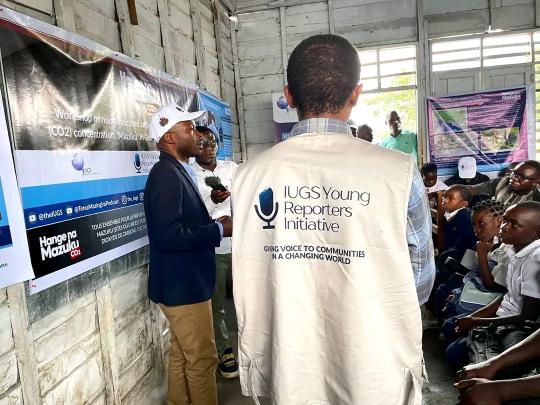
In response to this threat, public awareness-raising has emerged as an essential means of strengthening prevention and promoting a culture of vigilance within communities. It is against this background that the Young Reporters Initiative (YoRI), in collaboration with the International Union of Geological Sciences (IUGS), organised an awareness-raising session for pupils at Nyabyunyu Institute, located in the Lac Vert neighbourhood of Goma, in the eastern Democratic Republic of the Congo.
Held on 19 October 2026, the activity aimed to draw pupils’ attention to the dangers of Mazuku while familiarising them with the risks associated with high concentrations of CO₂ in their surroundings. Through this initiative, the organisers seek to promote the dissemination of scientific knowledge among young people and encourage responsible behaviour in the face of geological phenomena that can threaten human life.
The choice of Nyabyunyu Institute also reflects the importance of schools in promoting community-based prevention. By targeting the school environment, YoRI-IUGS is counting on pupils’ ability to share knowledge and safety messages with their families and respective communities. Schools thus become strategic spaces for improving understanding of environmental risks and encouraging greater awareness of information relating to public safety.
Beyond this one-off activity, the challenges posed by Mazuku highlight the need to strengthen public awareness efforts on a sustained basis, particularly in neighbourhoods experiencing rapid population growth. Identifying hazardous areas, educating communities about risks and making scientific information accessible to the public are important measures for reducing accidents. In a city where urbanisation continues to advance, prevention efforts must keep pace with residential expansion to ensure that people do not settle in areas whose dangers remain insufficiently understood.
In a report produced by Watoto Radio, with contributions from reporters Daniel Jasiri Levergénois Makasi Mahamba and Espérance Byamungu, and relayed by naturelcd.net, the key moments of this awareness-raising session held at Nyabyunyu Institute are brought into focus. The initiative serves as a reminder that, in the face of Mazuku, knowledge is a first line of protection and that educating young people remains an essential means of preventing tragedies associated with this natural phenomenon.